The Pool’s Pond Delight
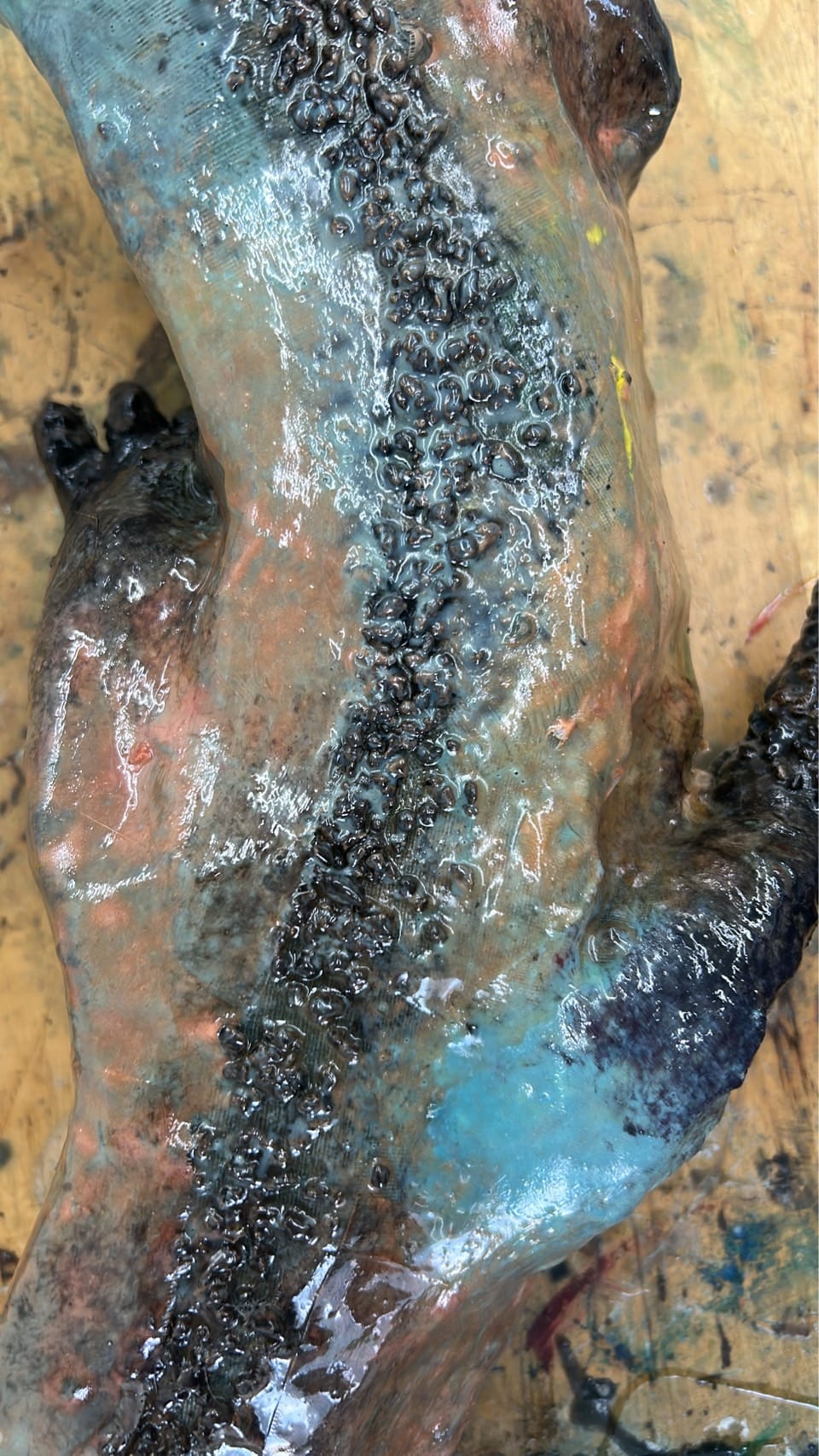
The Pool’s Pond Delight by Hadrien Gerenton
The Pool’s Pond Delight brings together a series of sculptures that construct an imagined landscape through the encounter of botanical forms, animals, human figures, and domestic objects. Wild dogs resting by the roadside, reptiles, hybrid companions, trees, and female figures populate a setting that initially appears calm and familiar. Yet this tranquility is accompanied by a sense of alertness: the landscape carries subtle indications of danger, as though its organisms have acquired an unfamiliar or potentially toxic quality. Together, these elements suggest an ecosystem shaped by transformation, where nature and artifice exist in an uneasy proximity.
The works begin with natural forms that are removed from their original contexts through casting, fabrication, and repetition. Lotus pods and tropical seeds are reproduced in resin, lead, and industrial paint, moving between their botanical origins and their new roles as sculptural objects. Withered lotus flowers become chairs, while seed forms are suspended as mobiles. Through these shifts, familiar forms acquire new scales, materials, functions, and contexts, turning traces of the natural world into objects of use and display.
This relationship between the natural and the constructed extends to the exhibition’s imagined inhabitants. Animals and hybrid figures occupy the landscape not simply as elements within a backdrop, but as presences around which the surrounding environment is organised. Domestic furniture takes on an organic character, while botanical forms acquire the weight and permanence of manufactured objects. The resulting landscape is populated by forms whose identities remain in constant negotiation between organism, object, and ornament.
The reference to Édouard Manet’s Déjeuner sur l’herbe (1863) situates this landscape within a longer history of representing the relationship between the human figure and nature. In Manet’s painting, the pastoral setting becomes the site of a disruption to the conventions of both social and pictorial space. A comparable tension emerges through the coexistence of familiar forms and their altered counterparts: the landscape remains recognisable, while the relationships between its inhabitants and objects have been rearranged.
The material construction of the sculptures reinforces this tension. Resin casts preserve the structures of lotus pods and seeds while introducing variations in colour and translucency. Bent-steel frameworks supporting the chairs recall the functional language of mid-century domestic design, placing organic forms within a recognisably manufactured structure. Above them, suspended mobiles form a contrasting presence: cast seeds rendered in lead and coated in polychromatic industrial paint introduce weight, opacity, and a distinctly artificial surface. The materials oscillate between the recognisable qualities of their botanical origins and the industrial processes through which they have been remade.
The sculptures can be encountered across several registers: as botanical specimens, domestic objects, sculptural forms, and images of nature. Their associations shift as they move between these contexts, allowing the familiar to become strange without entirely losing its original identity. The landscape remains suspended between growth and decay, attraction and danger, nature and manufacture—a place whose apparent tranquility is never entirely without consequence.